


Page 143 - Textos de Matemática Vol. 44
P. 143
n−2 [xAx ... A
λ λ2 ... λn−1 111
λ λ2 ... λn−1 222
. . . x]= . . ... .
λ λ2 ...λn−1 n−1 n−1 n−1
00...0
ON ALMOST NORMAL MATRICES 133
Sufficiency. Direct computations show that, under conditions (2.2), μ is an eigenvalue of A∗ which has multiplicity one, with the corresponding eigenvector equal en.
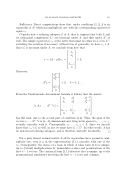
Consider now a reducing subspace L of A, that is, suppose that both L and its orthogonal complement L⊥ are invariant under A, and thus under A∗ as well. The simple eigenvector en of the latter then must lie either in L or in L⊥; switching the notation if necessary, without loss of generality we have en ∈ L. Since L is invariant under A, we conclude from here that
Moreover,
λ1 λ2
. x:=(A−μI)en = . ∈L.
λn−1 0
k .
A x= . ∈L, k=1,2,...
λk+1 n−1
λk+1 1
λk+1
2
0
From the Vandermonde determinant formula it follows that the matrix
has full rank, due to the second part of condition (2.2). Thus, the span of the vectors x, . . . An−2x is (n−1)-dimensional and, lying in the span of e1, . . . , en−1, actually coincides with it. Consequently, e1, . . . , en−1 ∈ L. Since we already knowthaten ∈Laswell,infactwemusthaveL=Cn.Inotherwords,Ahas no non-trivial reducing subspace, and is therefore unitarily irreducible.
For a pure almost normal matrix A all its eigenvalues have geometric mul- tiplicity one, even if μ in the representation (1.1) coincides with one of the λj. Consequently, the choice of a basis in which A takes form (1.1) is unique, up to (trivial) multiplications by unimodular scalars and permutations of the first n − 1 vectors. The canonical form (1.1) therefore also is unique, up to the permutational similarities involving the first n − 1 rows and columns.


