


Page 149 - Textos de Matemática Vol. 44
P. 149
ON ALMOST NORMAL MATRICES
139
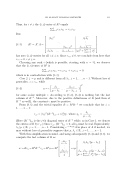
Thus, for i ̸= j the (i, j)-entry of R2 equals
nk=1 rikrkj = rinrnj.
But
|λn−1 | βn−1 λn−1 β1λ1 ... βn−1λn−1 |μ|2+ n−1βj2
j=1
has zero (i, j)-entries for all i ̸= j, n. Since rnj ̸= 0, we conclude from here that rin =0,i̸=j,n.
Choosing any such i (which is possible, starting with n = 3), we observe that the (i, n)-entry of R2 is
nk=1 rikrkn = rijrjn + rinrnn = 0,
which is in contradiction with (6.3).
Case 2. ζ = μ and is different from all λj, j = 1,...,n − 1. Without loss of
. .
|λ|2 βλ 111
2 (6.3) R2 =A∗A= .. .
generality, z = en, while
(6.4) y=c μ−λ ... μ−λ 1
β1 βn−1 T 1 n−1
for some scalar multiple c. According to (6.2), (6.4) is nothing but the last column of R−1. Moreover, due to the positive definiteness of R (and then of R−1 as well), the constant c must be positive.
From (6.3) and the trivial equality R = R2R−1 we conclude that for j = 1,...,n−1:
rjj = |λj|2 (R−1)jj + cβj2ηj, where ηj = λj . μ−λj
(Here (R−1)jj is the j-th diagonal entry of R−1 while, as in Case 1, we denote the entries of R by rij .) Since rjj , (R−1)jj > 0, all ηj must be real. Equivalently, λj/μ ∈ R, j = 1,...,n−1. Considering e−iargμA in place of A if needed, we maywithoutlossofgeneralitysupposethatμ,λj ∈R,j=1,...,n−1.
With this simplification in mind, and using subsequently (6.4) and (6.3), we compute the last column of R as
2 −1 w:=Ren =R R
β1 μ−λ1
β1λ1/(μ − λ1) ..
2 . . en =R y=cR βn−1 =cμ
2
. βn−1λn−1/(μ − λn−1)
μ−λn−1 μ + n−1 β2/(μ − λ ) 1 j=1j j


