


Page 15 - Textos de Matemática Vol. 44
P. 15
NATA´LIA BEBIANO’S LEGACY 5
[B86, C-numerical range]: This is Nat´alia’s earliest work in this area. Given complex n × n matrices A with eigenvalues αj and a diagonal matrix
C = diag(γ1,...,γn),
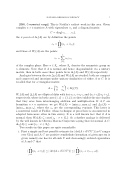
the σ-points of ∆c(A) are by definition the points n
zσ = (αj +βσj); i=1
and those of Wc(A) are the points
zσ = αjγσj
n j=1
of the complex plane. Here σ ∈ Sn, where Sn denotes the symmetric group on n elements. Note that if A is normal and hence diagonalizable via a unitary matrix, then in both cases these points lie in ∆c(A) and Wc(A) respectively.
Analogies between the sets ∆C (A) and WC (A) are studied: both are compact and connected and invariant under unitary similarities of either A or C. It is recalled that for a triangular matrix
 α1 α
A= 0 α ∈M2(C),
2
Wc(A) and ∆c(A) are elliptical disks with foci α1γi+α2γj and (α1+γi)(α2+γj), respectively, where in both cases {i, j} = {1, 2}; so they exhibit the nice duality that they arise from interchanging addition and multiplication. If A,C are hermitian n × n matrices, we get WC(A) = [minzσ,maxzσ] and ∆C(A) = [min zσ , max zσ ], where the zσ are the corresponding σ-points. This latter is a nontrivial result of Fiedler, whose technique of proof here is encountered in adapted form more often in this survey. It is a well known fact that if A is normal, then WC(A) ⊆ conv{zσ : σ ∈ Sn}. So a further analogy is delivered by the well known de Oliveira Marcus Conjecture saying that for normal A, C, ∆C(A)⊆conv{zσ :σ∈Sn}.
Two results in this paper are quite remarkable:
i. First a simple and best possible estimate for |det(A+iUCU∗)| as U ranges over U(n) and A,C are positive semidefinite hermitian of given spectra is given; namely one has for all such U and decreasingly ordered eigenvalues of A and C that
nn
| (αj +iγj)|≤|det(A+iUCU∗)|≤| (αj +iγn−j+1)|.
j=1 j=1


