


Page 32 - Textos de Matemática Vol. 44
P. 32
22 A. KOVACˇEC
Via this theorem the authors can conveniently pass from the line equation of Kippenhahn-Murnaghan type to a point equation for CJ (A) that generates WJ (A) as its pseudoconvex hull.
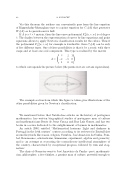
If A is a 3 × 3 matrix, then the line-curve polynomial FAJ (u, v, w) is of degree 3. The duality between the representation of curves by line equations and point equations allows to apply Newton’s classification results for the cubics. Thus if the polynomial FAJ (u, v, w) for example is irreducible, then CJ (A) can be only of five different types. One of these possibilities is that it be a sextic with three cusps and at least one oval component. This type is realized by the matrix
3 21 A=−2 −5 0
100
to which corresponds the picture below (the points in it are certain eigenvalues).
The example section from which this figure is taken gives illustrations of the other possibilities given by Newton’s classification.
**
We mentioned before that Nat´alia has articles on the history of portuguese mathematics, has written biographical studies of portuguese men of culture and mathematicians Bento de Jesus Carac¸a and Ruy Lu´ıs Gomes, and has two books in a series dedicated to the enlightenment of laymen in mathematics.
An article [B96] entitled “Mathematical horizons: Light and darkness in Portugal in the 18th century” centers according to its reviewer for Zentralblatt around keywords like reason, religion, Coimbra, Jos´e Anast´acio da Cunha, Pom- bal, Renaissance, scholasticism, humanism, experiment, algebra and geometry, and is ‘an attempt at recreating the contradictory intellectual atmosphere of the country, characterized by exceptional progress, followed by ruin and stag- nation’.
The chair of Geometry went to Jos´e Anast´acio da Cunha - poet, mathemati- cian, philosopher, a free thinker, a genuine man of culture, powerful enough to


