


Page 41 - Textos de Matemática Vol. 44
P. 41
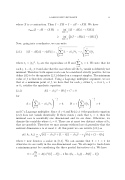
∥ξ∥=1 ≥ inf
∥ξ∥=1 Now, going into coordinates, we can write
∥(I − zH)ξ∥ − r∥Hξ∥ n
n
(2.1) ∥(I−zH)ξ∥−r∥Hξ∥= j=1
|1−zhj|2tj −r h2jtj
j=1
A RESOLVENT ESTIMATE 31
where X is a contraction. Then I − ZH = I − zH − rXH. We have σmin(I−zH−rXH) = inf ∥(I−zH)ξ−rXHξ∥
n
where tj = |ξj|2, hj are the eigenvalues of H and tj = 1. We note that for
j=1
each j, 1−zhj ̸= 0 and also that the case where all the hj vanish is definitely not
minimal. Therefore both square roots can be considered strictly positive. Let us define f(t) to be the quantity (2.1) defined on a compact simplex. The minimum value of f is therefore attained. Using a Lagrange multiplier argument, we see thatataminimumpointoff,wehavethatforeachj,eithertj =0ortj =1 or hj satisfies the quadratic equation
(2.2) for
A|1−zhj|2−Bh2j +C=0 −1 −1
A =
| 1 − z h j | 2 t j > 0 , B = r h 2j t j > 0 j=1 j=1
n2n2
and C a Lagrange multiplier. Since A > 0 and Re(z) ̸= 0 the quadratic equation (2.2) does not vanish identically. If there exists j such that tj = 1, then the minimal case is essentially one dimensional and we are done. Otherwise, we dismiss the variables where tj = 0. There are at most two distinct values of hj that are possible. Therefore we may assume without loss of generality that the ambient dimension n is at most 2. At this point we can rewrite (2.1) as
g(t,h1,h2) = (t|1−zh1|2 +(1−t)|1−zh2|2 −r th21 +(1−t)h2 def
where t now denotes a scalar in [0,1]. We can assume that 0 < t < 1 for otherwise we are really in the one-dimensional case. We attempt to track down a minimum point by considering the three partial derivatives of g. We have
0=2∂g =A(|z|2(h21 −h2)−2Rez(h1 −h2))−B(h21 −h2) ∂t


