


Page 59 - Textos de Matemática Vol. 44
P. 59
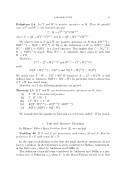
Therefore, with
PARALLEL SUMS 49
Definition 2.4. Let T and W be positive operators on H. Then the parallel sum of T and W is the bounded operator
T : W = (T1/2)C∗DW1/2,
where C = ((T + W)1/2)†T1/2 and D = ((T + W)1/2)†W1/2.
We observe that if T and W are positive operators on H then R(T1/2)+
R(W1/2) = R((T + W)1/2). If W0 is the restriction of W to N(W)⊥ then
W−1 : R(W) → N(W)⊥ is a closed operator. This implies that C = W−1T : 00
H → N(W)⊥ is closed. Then WC = T. Similarly, there exists D such that W =TD.
We notice that T : W = T(T +W)†W whenever X = (T +W)†W is well defined, that is, whenever R(W ) ⊂ R(T + W ). In particular this is always true if T + W has closed range.
Moreover, in [3] the following properties are proved.
Theorem 2.5. If T and W are bounded positive operators on H, then
(i) T : W is bounded and positive.
(ii) T:W=W:T.
(iii) (T:W)∗=T:W.
(iv) R((T : W)1/2) = R(T1/2) ∩ R(W1/2).
(v) R(T)∩R(W)⊂R(T:W).
We remark that the equality in Theorem 2.5-(v) is true if R(T : W ) is closed.
3. The 96th Halmos’ Problem In Halmos’ Hilbert Space Problem Book [4], we can find
Problem 96. If E and F are projections with ranges M and N, find the projection E ∧ F with range M ∩ N.
In the same book Halmos states that the usual algebraic operations do not lead to a solution. In the following it is given a solution for Halmos’ requirement, in the finite case, stated by Anderson and Duffin [2] .
The definition of parallel sum considered by Anderson and Duffin is a par- ticular case of Definition 2.2, when A− is the Moore-Penrose inverse of A, that
T1/2 = (T + W)1/2C and W1/2 = (T + W)1/2D, N((T + W)1/2) ⊂ N(C∗) and N((T + W)1/2) ⊂ N(D∗).


