


Page 86 - Textos de Matemática Vol. 44
P. 86
76 KH. D. IKRAMOV
For matrix (2.3), σ(AL) = {−1,−1} (see (2.4)); hence, μ1 = i, μ2 = −i.
Now, we invoke an important result from the theory of consimilarity trans- formations that is an analogue of the classical Jordan form theorem (see [2]).
Theorem 2.4. Every matrix A ∈ Mn(C) can be brought by an appropriate consimilarity transformation
(2.5) A → YA = P−1AP
to the form
(2.6) YA =J1 ⊕···⊕Ju ⊕G1 ⊕···⊕Gv ⊕Gv+1 ⊕···⊕Gv+w,
where the first u direct summands are conventional Jordan blocks corresponding to the nonnegative coneigenvalues of A. The middle v summands are matrices of the type
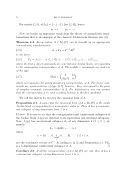
  0 Il  (2.7) G(μ) = Jl(μ2) 0
which correspond to the purely imaginary coneigenvalues of A. The last w sum- mands are again matrices of type (2.7); however, they correspond to the pairs of complex conjugate coneigenvalues of A. For definiteness, one can assume that the coneigenvalue μ in such a matrix belongs to the first quadrant.
We call the matrix YA in (2.6) the canonical form of A.
Proposition 2.5. Assume that the canonical form of A ∈ Mn(C) is the single Jordan block corresponding to a nonnegative scalar μ. Then A has a coninvari- ant subspace of any dimension from 1 to n.
Proof. It is easy to see that the coneigenvalues and coninvariant subspaces of the Jordan block Jn(μ) are identical to its eigenvalues and invariant subspaces. Now, Jn(μ) has an invariant subspace Lk of any dimension k (1 ≤ k ≤ n); namely,
where
Lk = span(e1,...,ek), ei = (0,...,0, 1 ,0,...,0),

i
1 ≤ i ≤ n,
are the coordinate vectors of Cn. According to (2.5) and Proposition 2.3, PLk
is a k-dimensional coninvariant subspace of A.
Corollary 2.6. If all the coneigenvalues of A ∈ Mn(C) are real, then A has a coninvariant subspace of any dimension from 1 to n.


