


Page 106 - Textos de Matemática Vol. 44
P. 106
96 N. KRUPNIK AND Y. SPIGEL
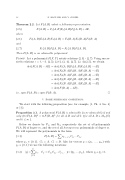
Theorem 2.2. Let F(A,B) admit a following representation:
(2.5)
where
(2.6)
and
F3(A, B)F4(A, B) = F4(A, B)F3(A, B). Then F(A,B) is an admissible polynomial.
Proof. Let a polynomial F (X, Y ) satisfy relations (2.5) - (2.7). Using succes- sively relations c = λ − d, (2.5), (2.6), (2. 4), (2.7), (2. 4),(2.5), we obtain
det (F (A, B) − λE) = det (F3(A, B)F0(A, B)F4(A, B) − cE) = det (F4(B, A)F0(B, A)F3(B, A) − cE) = det (F0(B, A)F3(B, A)F4(B, A) − cE) = det (F0(B, A)F4(B, A)F3(B, A) − cE) = det (F3(B, A)F0(B, A)F4(B, A) − cE)
= det (F (B, A) − λE) ,
i.e., specF(A,B) = specF(B,A).
3. Some necessary conditions.
We start with the following proposition (see, for example, [1, Ch. 4, Sec. 4]
or [3]).
Proposition 3.1. A polynomial F (A, B) is admissible (is m-admissible) if and only if trF(A,B)k = trF(B,A)k for all A,B and all k (for all A,B ∈ Mm(C) and k ≤ m ).
Below we denote by Pm and Hm respectively the set of all polynomials F(A,B) of degree m, and the set of all homogeneous polynomials of degree m. We will represent the polynomials in the form
(3.1) F(A,B) =  ap1...pkCp1...Cpk,
where pj ∈ {0,1}, C0 = A, C1 = B. Also for vectors p = (p1, ..., pm) with pj ∈ {0, 1} we use the following notations:
m
(3.2) |p|= pj, Cp:=Cp1Cp2...Cpm, p=(p1,...,pm), wherepj+pj=1.
j=1
(2.7)
F (A, B) = F3(A, B)F0(A, B)F4(A, B) + dE,
F3(A, B)F0(A, B)F4(A, B) = F4(B, A)F0(B, A)F3(B, A)


