


Page 108 - Textos de Matemática Vol. 44
P. 108
98 N. KRUPNIK AND Y. SPIGEL
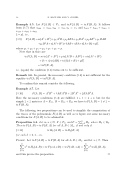
Example 3.5. Let F(A,B) ∈ P3. and trF(A,B) = trF(B,A). It follows from (3.7) that a000 = a111,a00 = a11,a0 = a1 and a001 + a010 + a100 =
a110 + a101 + a011 (:= p), i.e.,
(3.9) F(A,B)=m(A3+B3)+p1A2B+p2ABA+p3BA2+p4AB2+p5BAB +p6B2A+a(A2+B2)+bAB+cBA+d(A+B)+qE,
wherep1+p2+p3 =p4+p5+p6 =p. Note that in this case
trF(A,B)=mtr(A3 +B3)+ptr(A2B+AB2)+atr(A2 +B2) +(b+c)tr(AB)+tr[d(A+B)+qE]
= trF(B,A),
i.e. (again) the condition (3.4) turns out to be sufficient.
Remark 3.6. In general, the necessary condition (3.4) is not sufficient for the equality trF(A,B) = trF(B,A).
To confirm this remark consider the following Example 3.7. Let
(3.10) F (A, B) = A3B2 + 3ABA2B + 2B3A2 + 2BAB2A.
Here the necessary conditions (3.4) are fulfilled: 1 + 3 = 2 + 2, but for the simple2×2matricesA=E11, B=E12+E21 wehavetrF(A,B)=1̸=2= trF(B,A).
The following two propositions can be used to simplify the computation of the traces of the polynomials F(A,B) as well as to figure out some necessary conditions for F (A, B) to be admissible.
Proposition 3.8. Let m,n ∈ N, F ∈ Pm and F =  mk=0 Hk, where Hk ∈ Hk. Then trF(A,B) = trF(B,A) for all A,B ∈ Mn, if and only if
(3.11) tr Hk(A, B) = tr Hk(B, A)
for each k = 0, 1, ...m.
Proof. Let trF(A,B) = trF(B,A) for all A,B ∈ Mn, and let x ∈ C. Then mm
 xk trHk(A,B) = trF(xA,xB) = trF(xB,xA) =  xk trHk(B,A), k=0 k=0
and this proves the proposition.


