


Page 45 - Textos de Matemática Vol. 44
P. 45
ON APPROXIMATE GENERALIZED DERIVATIONS 35
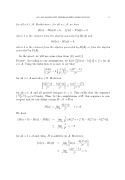
for all a, b ∈ A. Furthermore, for all a ∈ A, we have
(h(a) − H(a))b = 0, (f(a) − F(a))b = 0,
where b is the element from the algebra generated by H(A) and b(h(a) − H(a)) = 0,
where b is the element from the algebra generated by H(A) or from the algebra generated by F(A).
In the proof, we will use some ideas from [13] and [3].
Proof. According to our assumptions, we have   1 h(a) − h( a )  ≤ 1 ε1 for all
a ∈ A. Using the induction, it is easy to see that  h(a)   a    ε1(2n − 1)
 −h ≤
 2n 2n  2n
222
for all a ∈ A and all n ∈ N. Moreover,
 h(2ma) − h(2na)  ≤ ε1(2n − 2m)
  2m 2n   2m+n
for all a ∈ A and all positive integers m < n. This yields that the sequence
{h(2na)} is Cauchy. Thus, by the completeness of B, this sequence is con- 2n n∈N
vergent and we can define a map H : A → B as H(a) := lim h(2na),
a ∈ A.
We have
∥H(a + b) − H(a) − H(b)∥
= lim 1 ∥h(2na + 2nb) − h(2na) − h(2nb)∥ n→∞ 2n
≤ lim1ε1=0 n→∞ 2n
n→∞ 2n
for all a, b ∈ A and, thus, H is additive on A. Moreover,

∥h(a) − H(a)∥ = lim  h(a) −
n→∞
h(2n a)
2n
≤ limε1(2n−1)=ε1 n→∞ 2n


