


Page 46 - Textos de Matemática Vol. 44
P. 46
36 A. FOSˇNER AND M. SAL MOSLEHIAN
for all a ∈ A. For proving the uniqueness of H, suppose that there exists another
additive mapping H  : A → B such that  h(a) − H (a)  ≤ ε1 for all a ∈ A. Then   1
 H(a) − H (a)  = n  H(na) − H (na)  11
≤ n ∥H (na) − h(na)∥ + n  h(na) − H  (na)  ≤ 2ε1
n
for all a ∈ A and n ∈ N. By letting n → ∞, we conclude that H(a) = H (a) for all a ∈ A.
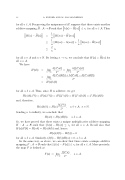
We have
for all a, b ∈ A. Thus, since H is additive, we get
H(a)h(2nb) = H(a(2nb)) = H((2na)b) = H(2na)h(b) = 2nH(a)h(b)
and, therefore,
H(a)h(b) = H(a)h(2nb), a,b ∈ A, n ∈ N. 2n
Sending n to infinity, we conclude that
H(ab) = H(a)H(b), a, b ∈ A.
So, we have proved that there exists a unique multiplicative additive mapping H:A→Bsuchthat∥h(a)−H(a)∥≤ε1 foralla∈A.Recallalsothat H(a)H(b) = H(ab) = H(a)h(b) and, hence,
H(a)(h(b) − H(b)) = 0
for all a, b ∈ A. Similarly, (h(b) − H(b))H(a) = 0, a, b ∈ A.
In the same way, as above, we can show that there exists a unique additive
mapping F : A → B such that ∥f(a) − F(a)∥ ≤ ε2 for all a ∈ A. More precisely, the map F is defined as
F(a) := lim f(2na), a ∈ A. n→∞ 2n
H (ab)
= lim
n→∞ = lim
h(2n ab) = lim h((2n a)b) 2n n→∞ 2n
n→∞
= H (a)h(b)
h(2na)h(b) + h(2nab) − h(2na)h(b) 2n


