


Page 50 - Textos de Matemática Vol. 44
P. 50
40 A. FOSˇNER AND M. SAL MOSLEHIAN
By letting n → ∞, we obtain
(π2 ◦φd)(a)=a, a∈A.
This yields that
φd(a)φd(b) =
= (π1(φd(a)), a)(π1(φd(b)), b)
(π1(φd(a)), π2(φd(a)))(π1(φd(b)), π2(φd(b))) = (π1(φd(a))b + aπ1(φd(b)), ab).
= (D(a)b + aD(b), ab).
On the other hand,
φd(ab) = (π1(φd(ab)), π2(φd(ab))) = (D(ab), ab).
Using (3.2), we get (D(ab), ab) = (D(a)b + aD(b), ab) for all a, b ∈ A. Hence, D(ab) = D(a)b + aD(b), as desired.
Step 2. D is unique.
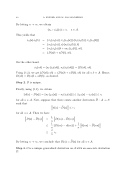
Firstly, using (3.1), we obtain
∥d(a) − D(a)∥ = ∥π1(φd(a)) − π1(φd(a))∥ ≤ ∥φd(a) − φd(a)∥ ≤ ε1
for all a ∈ A. Now, suppose that there exists another derivation D  : A → X such that
    d(a) − D (a)  ≤ ε1
for all a ∈ A. Then we have   1    D(a) − D (a)  = n  D(na) − D (na)
11   ≤ n ∥D(na) − d(na)∥ + n  d(na) − D (na)
≤ 2ε1. n
By letting n → ∞, we conclude that D(a) = D (a) for all a ∈ A.
Step 3. G is a unique generalized derivation on A with an associate derivation D.


