


Page 51 - Textos de Matemática Vol. 44
P. 51
ON APPROXIMATE GENERALIZED DERIVATIONS 41
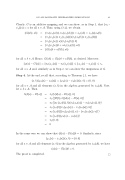
Clearly, G is an additive mapping and we can show, as in Step 1, that (π2 ◦ φg)(a) = a for all a ∈ A. Thus, using (3.2), we obtain
(G(ab), ab) =
= (π1 (φg (a)), π2 (φg (a)))(π1 (φd (b)), π2 (φd (b)))
(π1(φg(ab)),π2(φg(ab))) = φg(ab) = φg(a)φd(b)
= (π1 (φg (a)), a)(π1 (φd (b)), b)
= (π1(φg(a))b+aπ1(φd(b)),ab)
= (G(a)b + aD(b), ab)
for all a, b ∈ A. Hence, G(ab) = G(a)b + aD(b), as desired. Moreover, ∥g(a) − G(a)∥ = ∥π1(φg(a)) − π1(φg(a))∥ ≤ ∥φg(a) − φg(a)∥ ≤ ε2
for all a ∈ A and, similarly as in Step 2, we can show the uniqueness of G.
Step 4. At the end, recall that, according to Theorem 2.1, we have (x, b)(φd(a) − φd(a)) = (φd(a) − φd(a))(x, b) = (0, 0)
for all a ∈ A and all elements (x,b) in the algebra generated by φd(A). Now, let a,b ∈ A. Then
b(d(a) − D(a))
= π1(b(d(a) − D(a)), 0)
= π1 (D(b), b)(d(a) − D(a), 0)
= π1  (π1 (φd (b)), b)(π1 (φd (a)) − π1 (φd (a)), 0)  = π1  φd (b)(π1 (φd (a)) − π1 (φd (a)), 0)
= π1  φd (b) (π1 (φd (a)), a) − (π1 (φd (a)), a)   = π1  φd (b)(φd (a) − φd (a))
= π1(0,0)
=0
In the same way we can show that (d(a) − D(a))b = 0. Similarly, since (φg (a) − φg (a))(x, b) = (0, 0)
for all a ∈ A and all elements (x, b) in the algebra generated by φd (A), we have (g(a) − G(a))b = 0.
The proof is completed.


