


Page 93 - Textos de Matemática Vol. 44
P. 93
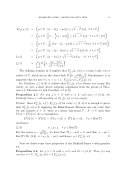
Fε (χ;ψ) ∥·∥
=  μ∈C:∥ψ−λ(χ−μψ)∥≥ 1−ε2∥ψ∥, ∀λ∈C
    1
= μ∈C: ψ−λ(χ−μψ) ≥ 1−ε2∥ψ∥, ∀λ∈C\{0}
 1   = μ∈C: |λ|∥λψ−(χ−μψ)∥≥ 1−ε2∥ψ∥, ∀λ∈C\{0}
=  μ∈C:∥χ−(μ−λ)ψ∥≥ 1−ε2∥ψ∥|λ|, ∀λ∈C  =  μ∈C:∥χ−λψ∥≥ 1−ε2∥ψ∥|μ−λ|, ∀λ∈C
BIRKHOFF-JAMES ε-ORTHOGONALITY SETS 83
(2.2)
(2.3)=Dλ,√ .
    ∥χ−λψ∥
1 − ε2 ∥ψ∥
The defining formula (2.3) implies that Fε
λ∈C
(χ;ψ) is a compact and convex subset of C, which lies in the closed disk D  0, √ ∥χ∥  . Furthermore, it is
apparent that for any 0 ≤ ε1 < ε2 < 1, Fε1 (χ;ψ) ⊆ Fε2 (χ;ψ). ∥·∥ ∥·∥
By Corollary 2.2 of [9], it follows that Fε (χ;ψ) is always non-empty. For ∥·∥
clarity, we give a short proof, adopting arguments from the proofs of Theo- rem 2.1, Theorem 2.2 and Corollary 2.2 of [9].
Proposition 2.1. For any χ,ψ ∈ X with ψ ̸= 0, and any ε ∈ [0,1), the Birkhoff-James ε-orthogonality set Fε (χ;ψ) is non-empty.
Proof. Since F0 (χ;ψ) ⊆ Fε (χ;ψ) for every ε ∈ [0,1), it is enough to prove ∥·∥ ∥·∥
that F0 (χ;ψ) ̸= ∅. Applying the Hahn-Banach Theorem one can verify that ∥·∥
for any nonzero ψ ∈ X, there is a linear functional T : X → C such that T (ψ) = ∥T ∥ ∥ψ∥. As a consequence,
∥T∥∥ψ∥ = |T(ψ)| = |T(χ+ψ)| ≤ ∥T∥∥χ+ψ∥, ∀χ∈Ker(T), and hence,
∥·∥
(2.4) ψ ⊥BJ χ, ∀χ ∈ Ker(T).
For the scalar μ = T(χ) , we have that T(χ−μψ) = 0, and thus, χ−μψ ∈
∥·∥
1−ε2 ∥ψ∥
∥T∥∥χ∥
Ker(T).By(2.4),ψ⊥BJ (χ−μψ),andhence,μ∈F0 (χ;ψ).
∥·∥
Next we derive some basic properties of the Birkhoff-James ε-orthogonality set.
Proposition 2.2. Let χ,ψ ∈ X with ψ ̸= 0, and let ε ∈ [0,1). Then, for any
nonzero b ∈ C, Fε (χ;bψ) = 1 Fε (χ;ψ). ∥·∥ b ∥·∥


