


Page 95 - Textos de Matemática Vol. 44
P. 95
√ ∥·∥1 ∥·∥1
Fε2 (χ;ψ). ∥·∥
∥·∥
and F
BIRKHOFF-JAMES ε-ORTHOGONALITY SETS 85
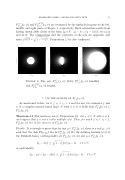
0.75(χ; ψ) are estimated by the unshaded regions in the left, middle and right parts of Figure 1, respectively. Each estimation results from having drawn 2000 circles of the form {μ ∈ C : |μ − λ| = ∥χ − λψ∥}; see (2.2) and (2.3). The compactness and the convexity of the sets are apparent, and
since √0.75 =  1 − 1−0.52 , Proposition 2.4 is also confirmed. 3
888
666
444
222
000
−2 −2 −2
−4 −4 −4
−6 −6 −6
−8 −8 −8
−8 −6 −4 −2 0 2 4 6 8 −8 −6 −4 −2 0 2 4 6 8 −8 −6 −4 −2 0 2 4 6 8
Real Axis Real Axis Real Axis
Figure 1. The sets F0.5 (χ;ψ) (left), F0.5 (χ;ψ) (middle), √ ∥·∥2 ∥·∥1
0.75(χ; ψ) (right). ∥·∥1
ψ of a complex normed linear space X with ψ ̸= 0, it holds that Fε1 (χ;ψ) ⊆
F 0.5 (χ; ψ) and F
Imaginary Axis
Imaginary Axis
Imaginary Axis
3. On the growth of Fε ∥·∥
(χ;ψ)
As mentioned before, for 0 ≤ ε1 < ε2 < 1 and for any two elements χ and
Theorem 3.1 (For matrices, see [6, Proposition 2]). Let χ, ψ ∈ X with ψ ̸= 0,
andsupposethatχisnotascalarmultipleofψ.Then,forany0≤ε1 <ε2 <1,
Fε1 (χ;ψ) lies in the interior of Fε2 (χ;ψ). ∥·∥ ∥·∥
Proof. It is enough to prove that for any μ ∈ Fε1 (χ;ψ), there is a real ρμ > 0 ∥·∥
such that the disk D(μ, ρμ) lies in F ε2 (χ; ψ). By the defining formula (2.2) of ∥·∥
the Birkhoff-James ε-orthogonality set F ε (χ; ψ), for any μ ∈ F ε1 (χ; ψ), ∥·∥ ∥·∥
∥χ−λψ∥ ≥  1−ε21∥ψ∥|μ−λ|, ∀λ∈C, ∥χ−μψ+(μ−λ)ψ∥ ≥  1−ε21∥ψ∥|μ−λ|, ∀λ∈C.
or equivalently,


